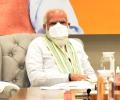
'I would like to convey the message to your readers that the prime minister himself is directly seized of the situation on the ground. He periodically reviews the situation on the ground and how it is moving forward, taking inputs from economists, business leaders, chambers of commerce.'
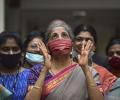
'Prime Minister Modi stated several times that we shall not let this challenge go away without converting it into an opportunity to undertake systemic reforms.' 'And hasn't that been reiterated in action?'

The arbitration of any court is legally binding and the government) can approach the Singapore high court.
From road transport to health insurance, tax rules have changed from October 1.

'The CEA suggested that could be as high as 19 per cent.'
The high court's order, which says refunds paid on service inputs can be restricted, runs contrary to Gujarat HC verdict and could complicate matters.

For India to be atmanirbhar, domestic manufacturers cannot remain merely assemblers of imported parts. Manufacturing in India cannot survive on support of imports forever.

This may leave those not opting for any of the two options offered by the Centre before the GST Council meet scheduled for October 5 in the lurch. It is clear from the present situation that these states will have to wait till June 2022 to get their compensation, subject to the council extending the cess collection period beyond June 30, 2022.

While most economies contracted in the second quarter of 2020, the Chinese economy grew by 3.2 per cent.

While other states are becoming competitive, Gujarat, say experts is not paying enough attention to maintaining its own position in terms of business reforms.

The McKinsey report said faster employment growth at 12 million non-farm jobs annually is needed in the post-Covid period till 2029-30, up from just four million created each year between 2012 and 2018.

If imputed inflation for April and May is used, then you have inflation of over 6 per cent for two consecutive quarters, which is a worrying signal for the RBI.
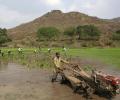
Much of the rural recovery story is based on the premise of agriculture doing well. Even if it clocks a growth of 2.5-3 per cent this year, it is still just around 15 per cent of the overall GDP. The non-farm sector, which constitutes a bigger portion of the overall rural economy, is now hampered by disruptions and lockdowns.
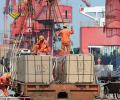
Outbound shipments of engineering products in June to these nations doubled to $1.32 billion in June 2020, from $653.52 million in June 2019.
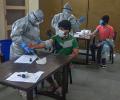
The ministry of health and family welfare spent Rs 3,948 crore in May this year compared to Rs 7,816 crore in the corresponding month of the previous year. On the other hand, at Rs 12,930 crore, the expenditure had risen almost 200 per cent in April against Rs 4,327 crore in the corresponding month of 2019-20.

Rajan said that while there were talks about Jan Dhan, it was difficult to target transfers to people through this tool. Jan Dhan, he said, does not really work as advertised.
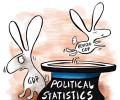
There has been criticism of the official statistics ever since MoSPI came out with new methodology to estimate the GDP on the base year of 2011-12 compared to earlier 2004-05.
Experts say a large part of the expenditure in April was spent on heads such as creating infrastructure for testing capacity and procuring testing kits, among other things.
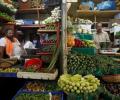
Since March 2020, WPI food inflation rate continued to fall but the CPI-food inflation rose, signaling a breakdown in supply chain from the mandis to the final household.

The inflows came higher in March than in February of 2019-20 despite the lockdown for a week, reports Indivjal Dhasmana.
 © 2025 Rediff.com - Investor Information - Advertise with us - Disclaimer - Privacy Policy - Sitemap - Feedback - About us - Terms of use - Grievances